Destination Spotlight

Enjoying Mt. Adatara in Autumn

Enjoying Mt. Adatara in Autumn

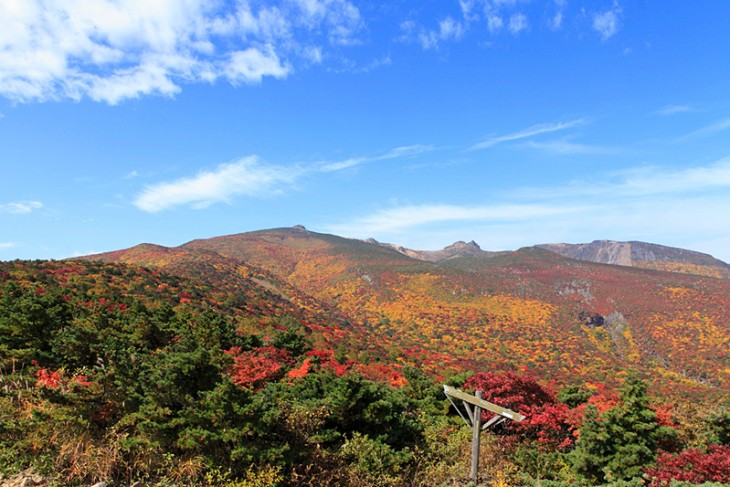
Mt. Adatara is one of Fukushima Prefecture’s most spectacular places to go and see the bright colours of the autumn leaves, in a custom that is called 'momiji-gari' in Japanese. I went to Mt. Adatara in Nihonmatsu to try and do some momiji-gari of my own! I was a little worried about hiking Mt. Adatara before I went because I have a bad sense of direction, so I wanted to write this blog to give some tips to those interested in visiting!

WHERE TO START?

The most simple hiking route – and definitely the most popular one in the autumn season – starts with the Mt. Adatara Rope-way. This rope-way is located at the Adatara Kogen Ski Resort, in Oku Dake (see map below).


TRAVEL TIP

During the autumn, there are a number of daily shuttle buses between Dake Onsen town and the rope-way. There is also often a shuttle bus service leaving from Nihonmatsu Station, which takes 50 mins.


TAKING THE ROPE-WAY TO YAKUSHI PEAK
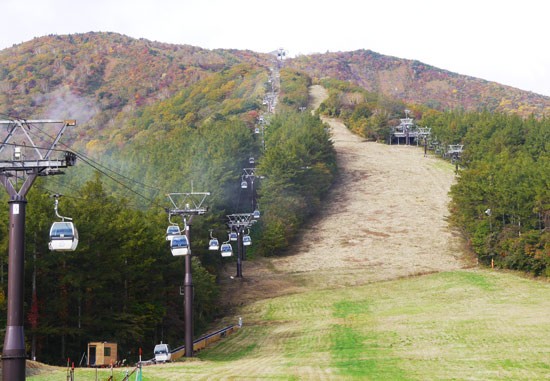
The 10-minute journey on the Mt. Adatara Rope-way is incredibly scenic, regardless of the time of year.
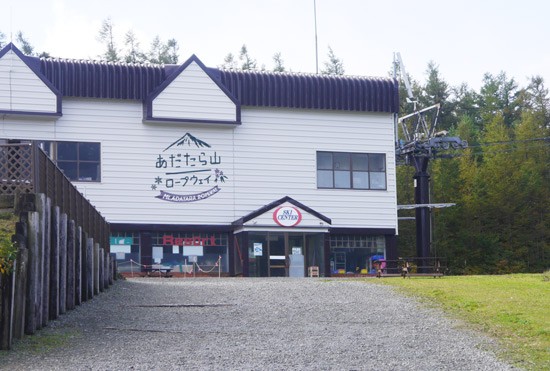
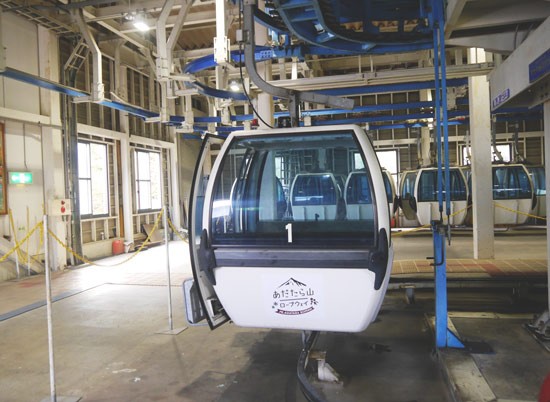
  • Price: 1,050 yen one-way. 1,750 yen return.*
  • Opening hours: The rope-way tends to be open from late April to early November. Please make sure to make a note of the last return rope-way trip when you visit, to make sure you don't get stranded at the viewpoint!

*Correct as of June 2020
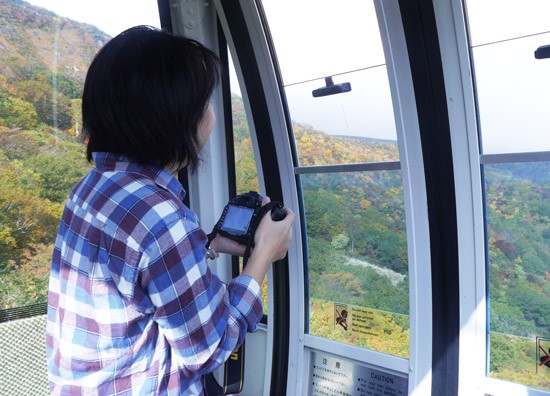
When you get off the rope-way, it is a short walk to Yakushi Dake Peak, which is a very popular photo spot. Many people come here just to take photos, then go back down the rope-way and go have their lunch or dip in an onsen! I’ve done this before actually, but this time we wanted to do the full basic hike.

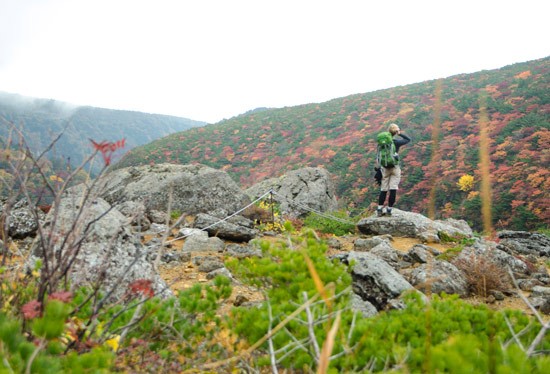
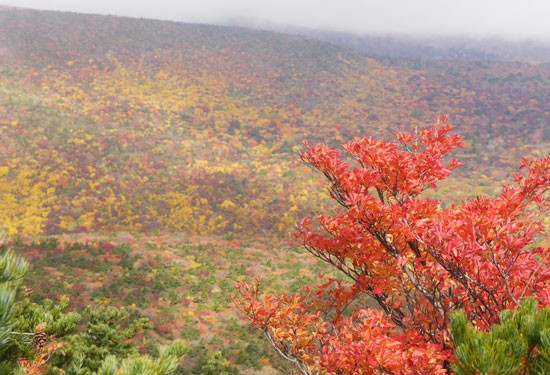
We happened to plan our trip to Mt Adatara on a very, very cloudy day – which was unfortunate! But you can tell just how bright the colours of the leaves on the mountain were from the photo below.


MISTY HIKE TO THE TOP OF MT. ADATARA

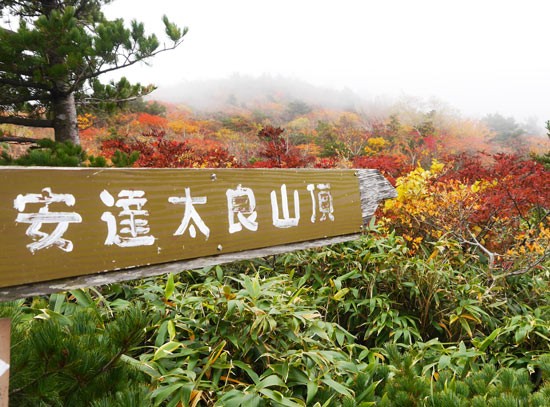
It turns out I didn’t need to worry about getting lost – the route to the top was well signposted – albeit just in Japanese.

TRAVEL TIP

Make sure you know the kanji words for the places you want to go before you set off on your hike! 安達太良山頂 – Peak of Mt. Adatara (adatara sancho), 奥岳 – Oku Dake (where the hike begins)
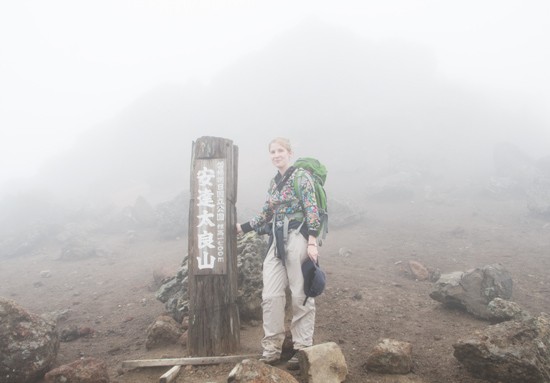
I was pretty disappointed that, despite being able to see the leaves from the bottom of the rope-way, after departing from the Yakushi Dake view spot, the mist got more and more intense. Check out the amazing views I got from the peak of the mountain!

AUTUMN COLOURS SHINING THROUGH

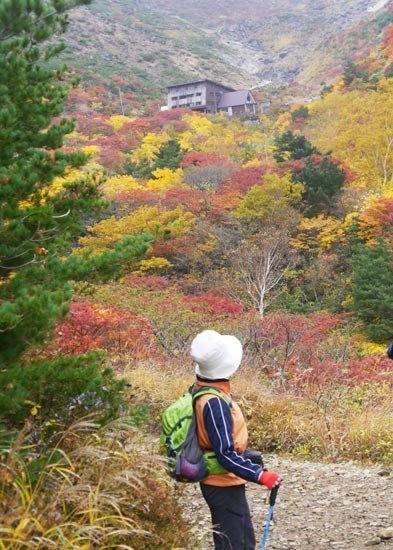
Luckily, the weather began to take a turn for the better on the way to our next destination – Kurogane-goya Mountain Lodge.
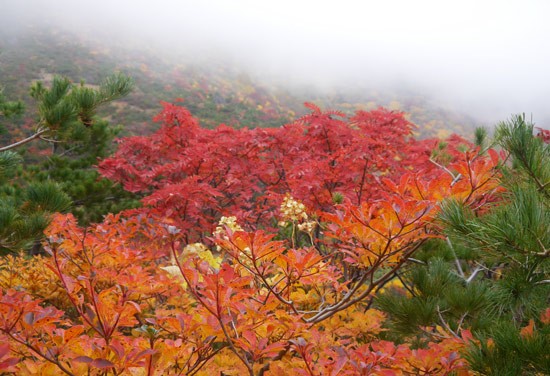
Going from being able to see nothing but white, to being surrounded by colour was a very odd experience! It was a little frustrating, as I realized I could have been seeing amazing sights for the last hour. However, I was so happy to get to enjoy the fantastic views that I soon forgot about my woes.
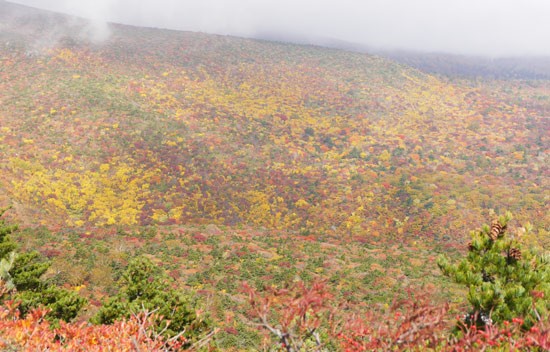
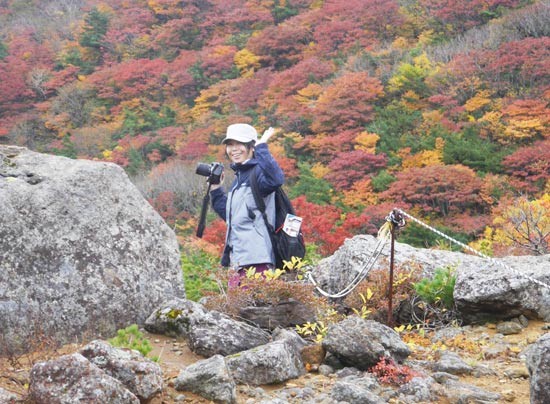
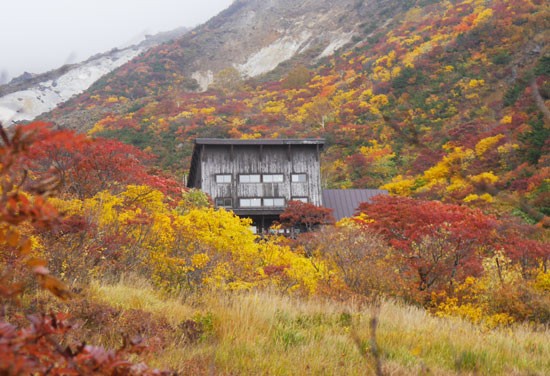
Soon we were able to see our lunch stop, the mountain lodge, off in the distance. It’s the lone building in the photo below.
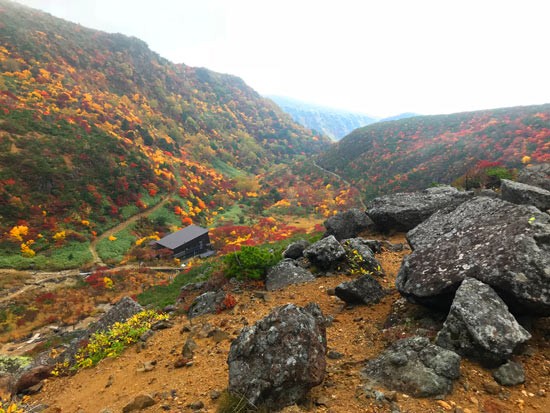

LUNCH AT KUROGANE-GOYA

2023 Update: Kurogane-goya Lodge is currently closed. We apologize for the inconvenience.

Kurogane-goya Mountain Lodge acts as a rest stop for hikers passing through, as well as being a place to stay the night for those going on longer hikes.
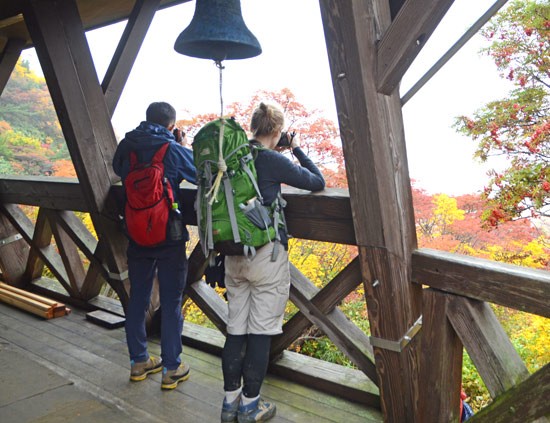
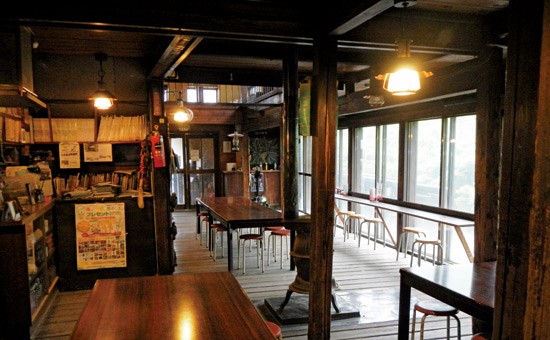
The inside decor of the Kurogane-goya Mountain Lodge is nearly completely made of wood. The vintage style lamps and wood stove burner give it a very homey and welcoming feel. I would love to stay here in winter, all warm and comfortable by the fire, despite the heavy snow outside.
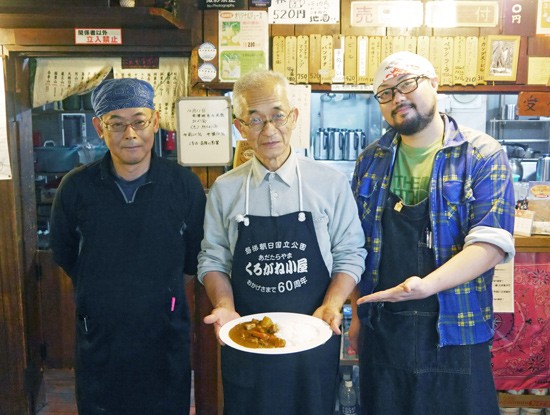
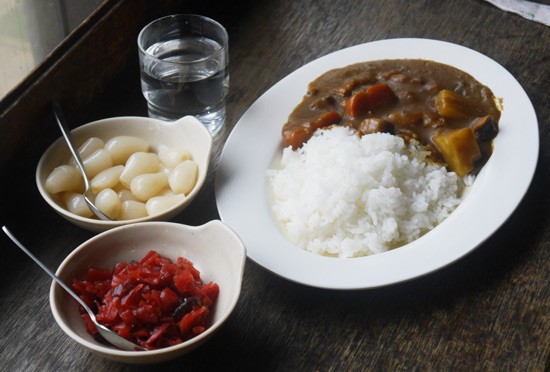
One thing that is quite well-known about Kurogane-goya is the delicious curry they serve to customers who stay overnight! Even though we didn’t stay overnight on this occasion, we got to sample the curry since we were visiting for a photo shoot. It did not disappoint!
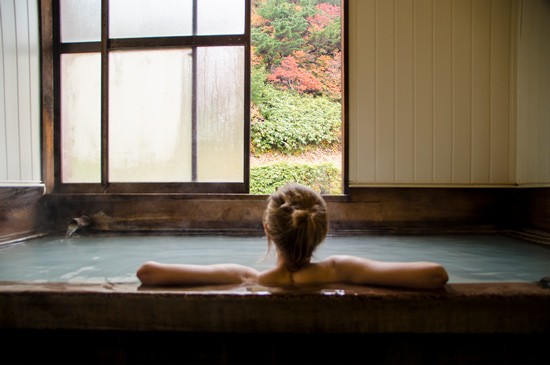
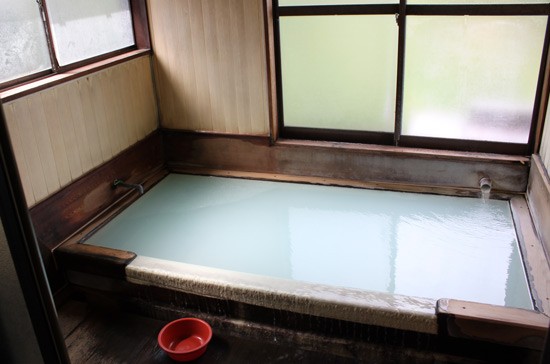
There is also a public hot spring facility built into the lodge, complete with amazing, cloudy water straight from a nearby source. I cannot describe how great it feels to get in a hot onsen after hiking for an hour or so. I only had time for a 10-minute dip, but even that was enough to make my body feel physically refreshed. You can use the onsen even if you aren’t spending the night at the lodge. Just remember to bring a towel and prepare to share your bath with other weary hikers!
We were blessed with better weather for our hike on the way back from Kurogane-goya Mountain Lodge.
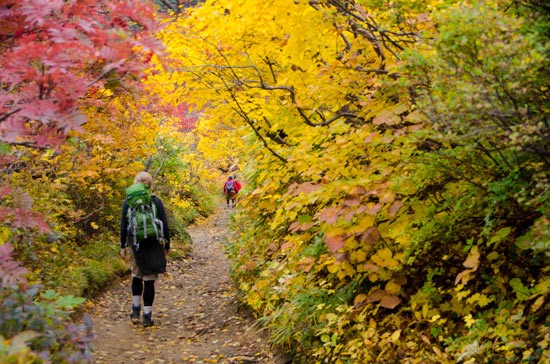
The path back to Oku Dake from Kurogane-goya is lined by tall trees for most of the hike, unlike the route to the top of Mt. Adatara which (is supposed to have) panoramic views!
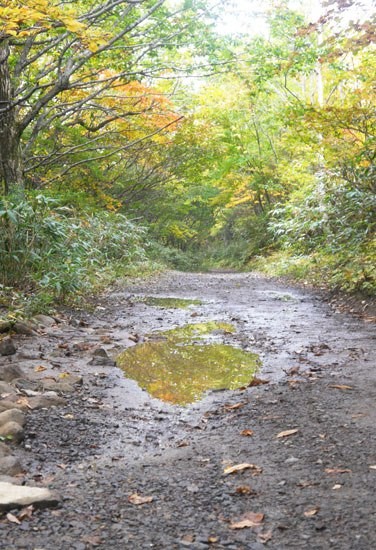
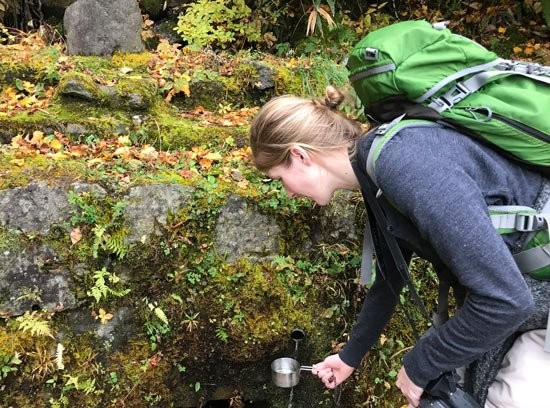
On the way down, I spotted a pipe from where you can drink fresh water from the mountain. They even provide you with what looks like a tiny saucepan!

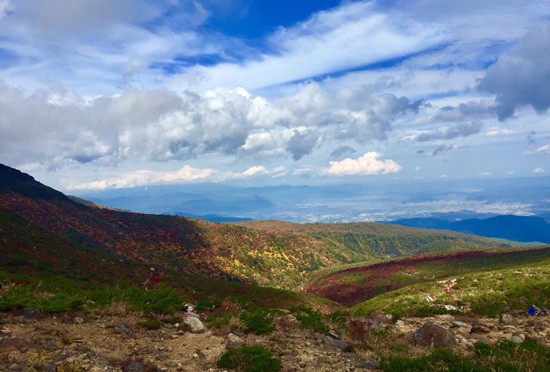
As we got closer to the end of our hike, one of my colleagues showed me a few photos he had taken the week before when he went hiking here… I was gutted that the weather hadn’t been better on the day of my visit!


OKUDAKE ONSEN

Back at Okudake, from where the hike started, we decided to check out the onsen before heading back to the office. This onsen is called Okudake no Yu. The water is not as cloudy as at Kurogane-goya, and the temperature is a bit cooler, but the water still felt amazing. The outside baths also look like infinity pools!
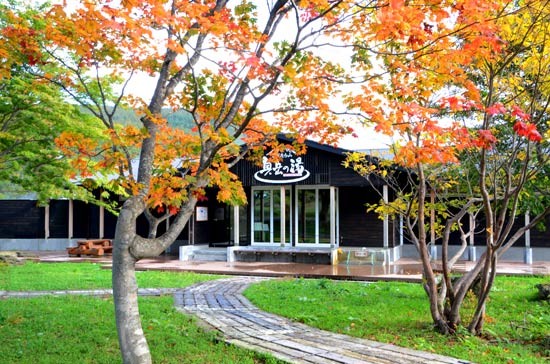
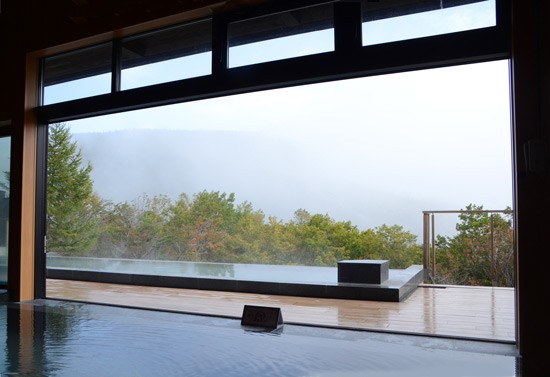
I definitely recommend visitors to stop by at one of these onsen and have a rest before returning home after their hikes – it is an amazing feeling!


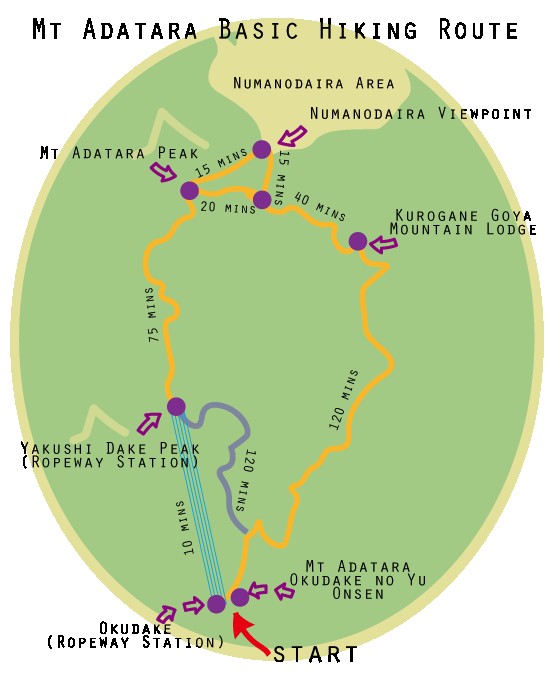
HIKING ROUTE

Here is a little illustration of the route that we hiked. I hope that it is helpful.
Latest posts

  1. Useful Information

    Hot Laps Experience at Ebisu Circuit

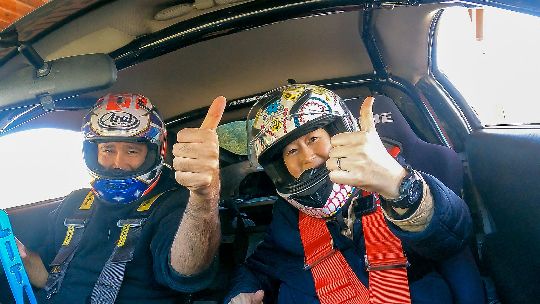
    Ever since the concept of drift racing was born in Japan in the 1970s and 80s, drifting culture has steadily increased in popularity to become a global phenomenon. These days, elite drift racers appear in competitions across the world in highly-modified cars, burning through tyres and kicking up smoke wherever they go.The technique involved in drifting is simple to understand but difficult to master – drivers hone their skills over years to perfect the difficult technique of sending the car sliding sideways through corners at full speed. Japan’s legendary car culture and natural abundance of mountain pass roads – known as ‘touge’ – made it the perfect ecosystem for the birth of this wild and exciting motorsport.Drifting is a part of Japan’s underground culture, and there’s nowhere better to experience it for yourself than at the circuit known as ‘drifting Mecca’.What is the Ebisu Circuit?Based just outside of Nihonmatsu City, the Ebisu Circuit is home to several full-size tracks. Some of these are designed for drifting full-time, while others are more for traditional ‘grip’ racing, and only open for drifting during the thrice-annual Ebisu Drift Festival.The circuit also houses several drift schools, the biggest of which is the Sideways Experience. In addition to running classes and renting vehicles to visitors to the circuit, the Sideways crew also provide a Hot Laps experience, letting you ride along in a real drift car as it whips you around the track.The Hot Laps ExperienceIf you’re into drifting culture, or just like cars, or even just want a rollercoaster-style shot of adrenaline, the Hot Laps at Ebisu make for a pulse-pounding experience.We went to try it for ourselves, visiting The Sideways Experience at their headquarters at the Kita (north) course, and then jumping into the passenger seat to take a few loops around the track.If you’ve never been in a drift car before, it is a sensory overload, from the smell of burning rubber to the screech of tyres as the pro drivers swing around corners. Although you’re tightly cinched into your seat by a racing seatbelt, the dramatic momentum shifts and high speeds make for a thrilling time on the track.Bookings can be made in advance on the reservation page.All members of the Sideways team speak English and can help you with any concerns or problems.Ride & DriveAs a working drift school, Sideways also offer the possibility of getting behind the wheel for yourself and learning the basics of drifting from a professional teacher. This was a great eye-opener for me, as I had no idea just how complex it is to send a car into an extended drift. I also managed to throw in a few doughnuts for the camera!The Ride & Drive experience also gives you a chance to jump into a Toyota AE86 (known as a hachi-roku, eight-six), a legendary car made famous by the manga and anime Initial D. Those booking this experience also get to jump in the AE86 for their Hot Laps, so if you’d like to learn to drift in an AE86 on a Japanese track, this is your chance.The AE86 Ride & Drive experience is currently being prepared and aims to be open for bookings sometime in spring 2026. Thank you for your patience.Q&AWhat do I need to bring?A driver’s license is not required to do either the Hot Laps experience nor the Ride & Drive. Helmets can be borrowed on-site.How much does it cost?The Hot Laps experience is a flat fee of 25,000 yen per person for three laps. The car only has room for one passenger at this time. Passengers must pay a separate fee of 2,200 yen at the front gate for ridealongs, which includes a 500 yen mandatory insurance.The exclusive Ride & Drive experience in the AE86, opening soon, costs 66,000 yen, and includes the Hot Laps experience followed by two 10 minute sessions with a professional driver on the Kuru Kuru Land drift pad. Drivers must pay a separate fee of 3,000 yen at the front gate, which includes the 500 yen insurance.Can I choose my favourite track?Visitors can choose from one of Ebisu Circuit’s famous tracks for the Hot Laps – Kita (north), Nishi (west) or Touge (mountain pass). Please be aware that some tracks are sometimes unavailable on event days or special occasions.Is there an age or height restriction?In general, there are no restrictions, but participants must be tall enough to be cinched into a racing seatbelt across the chest.Can I rent a car and drive for longer?For car rentals, please contact the Sideways Experience directly.Getting to the Ebisu CircuitWhile driving up from Tokyo is possible, it's a long journey - upwards of three and a half hours - that mostly sticks to highways and can be costly for toll roads.Many visitors choose to take the shinkansen (bullet train) as far as Koriyama Station - taking about 75 minutes from Tokyo Station - then rent a car there to drive to the circuit. Popular rental services include: Toyota Times Car Rental ORIX JR Rent-A-CarThese all have stores at Koriyama Station and can be reserved online in English.(Overseas visitors using rental cars must have a valid license to drive in Japan, such as an International Driver's Permit acquired in your home country..)Taking a local train as far as Nihonmatsu Station, then a taxi to the circuit, is also a potential option, since the Sideways Experience staff will pick you up from the front gate of the circuit.Helpful Links: Things to Do in Nihonmatsu City A Total Guide to the Ebisu Drift Festival Getting to Fukushima Top 10 Things to Do in Fukushima Cultural activities in Fukushima

    Hot Laps Experience at Ebisu Circuit
  2. Useful Information

    Exploring A Fukushima Footpath Course

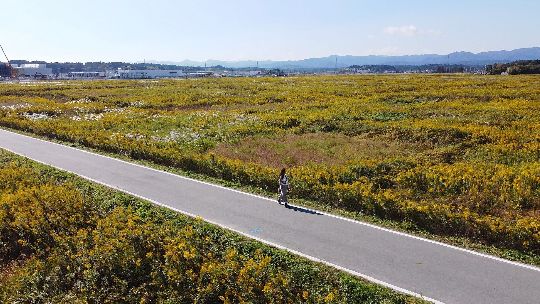
    In 2026, Fukushima’s east coast is no longer defined solely by its past. Along the Pacific shoreline, towns once struck by disaster are gradually filling with new buildings, new businesses and cautious optimism. One of the most revealing ways to understand this transformation is simply to walk through it, map in hand, on a Fukushima Footpath walking tour.What is a Footpath course?Threading through towns along Fukushima’s east coast, a Footpath course is a self-guided walking route that particularly explores areas heavily affected by the earthquake, tsunami and nuclear accident of 2011. These courses follow ordinary streets, coastal paths, shrines, parks and newly developed districts, with visitors using a map to explore at their own pace, stopping where they choose and taking time to absorb the surroundings.The initiative began as a way to draw people back to communities still rebuilding their numbers following the 2011 evacuation order. By encouraging visitors to walk through these towns, the project aims to increase awareness of both the disaster’s impact and the steady, visible progress of reconstruction. On foot, you can see details that would otherwise pass unnoticed; new seawalls, freshly laid roads, modern public buildings, and empty plots waiting for future homes.What makes them worthwhile?Walking these courses with friends turns the experience into something more than simply sightseeing. You might find yourself chatting with a shop owner in a newly opened café or meeting residents who have recently returned. Spending money locally – even on a coffee or lunch – directly supports communities rebuilding from the ground up.You’ll see construction sites beside quiet fields, or brand-new community centers next to long-standing shrines. The courses offer visitors a chance to see the region with their own eyes, and witness firsthand how the coastline is reshaping itself day by day with the support of its vibrant and regrowing community.Futaba: A link from yesterday to tomorrowFutaba, once home to thousands of residents, became the last municipality in Fukushima Prefecture to reopen after the disaster. Today, its population is still small, and walking here makes for a quiet but reflective afternoon. The course begins at the Great East Japan Earthquake and Nuclear Disaster Memorial Museum, a beautiful facility completed in 2020 as an archive detailing life before, during and after the 2011 tragedy.Next door is the Futaba Business Incubation and Community Center (F-BICC), equally modern with restaurants, conference facilities and a great view from the rooftop.From there, visitors walk through Futaba’s natural scenery, through wide plains where neighbourhoods once stood, while ongoing infrastructure work indicates the area’s rapid progress. In Futaba alone, there is a large hotel under construction by the museum, while the planned Fukushima Reconstruction Memorial Park is taking shape along the coast, designed as a large green space for reflection overlooking the Pacific.The walking course takes trekkers past Nakano Hachiman Shrine, famously rebuilt after once being swept away by the tsunami, and a rare example of a newly built shrine building.Further uphill, Morotake Suwa Shrine sits among trees, offering a view across the town toward the Pacific Ocean, with a small memorial to those who found refuge there during the tsunami.Eventually the course leads to the Asano-Nenshi textile factory, built here in 2023. Masami Asano, company president, chose Futaba as the site for the new factory to promote and stimulate Futaba’s economic recovery.The factory now stands as a beacon for Futaba’s revival, and contains a cafe restaurant where visitors can stop for lunch.Okuma: Forging new infrastructureLike Futaba, Okuma is in the midst of large-scale reconstruction. Entire districts are newly built or being developed, creating a townscape that blends fragments of the old with ambitious new planning. The footpath loops through the former downtown area, where parts of the historic main street survive alongside wide new roads and modern housing for returning residents.The route begins at the contemporary multipurpose complex CREVA, with coworking spaces and event halls reflecting the town’s focus on attracting businesses and entrepreneurs. Nearby, Kuma Sun Terrace provides a convenience store, restaurant, kid’s play room and everyday services.The new Ono Station building connects the town to Joban Line railway, while rows of azaleas and ginkgo trees line sections of the route.Further along stands Fun Eat Makers, a modern wooden facility combining a café and a hydroponic farm that grows produce using advanced indoor techniques. Nearby, the Okuma Incubation Center was once an elementary school, and now hosts companies and community events. Officials have suggested that in five or ten years, the town may look entirely different again. Walking the footpath today captures Okuma at a pivotal moment – actively constructing the infrastructure and social spaces that will define its next chapter.Hirono: At one with natureSouth of Futaba and Okuma, Hirono has a peaceful farmland atmosphere, reminiscent of even a European countryside. Beginning at a renovated Hirono Station – with a new community exchange center scheduled to open nearby – the footpath quickly transitions from town streets to open greenery.Tsukijigaoka Park provides an early highlight, including a monument connected to a well-known children’s song associated with the area. Beyond the park, vivid green rice paddies stretch across the landscape in growing season, backed by low hills.Walking under the Joban Line railway bridge, you may be lucky enough to watch a train passing overhead on its way headed north to Sendai or south to Iwaki.As the path approaches the Asamigawa estuary, the horizon opens toward the Pacific. The Oshu Sunrise Viewpoint draws visitors in the early morning, when light spreads across the water. Coastal windbreak forests and disaster-prevention green spaces line the shore, representing both preparedness and resilience.Together, Futaba, Okuma and Hirono reveal different aspects of Fukushima’s east coast in modern times: a mixture of reconstruction, natural beauty and cultural significance. By walking a Footpath course, you can witness these changes at a leisurely pace – and see for yourself how the region is reshaping its future.Looking for other ideas during your visit? Check out more details about the Hamadori region, and learn more about the Footpath programme (Japanese language only) on the official website.

    Exploring A Fukushima Footpath Course
  3. Useful Information

    5 Experiences in Fukushima with a Local Guide

    Did you know that there are cultural experiences in Japan that come with their own guide? Many visitors choose to take advantage of the wide array of local experts during their visit to Fukushima.Some say exploring Japan with the help of a local is the best way to travel – someone who knows their way around, can show you hidden spots, answer questions and deepen your understanding of the area.Why does the scenery look like that? What causes that natural phenomenon? What’s the history behind this spot? These are all questions that a local guide can answer for you during your trip. With that in mind, here are our recommendations for some activities you can try in Fukushima with the help of an experienced guide, both for solo travellers or group trips.1. Aizu Lacquerware Painting ExperienceCreate your own piece of a 400-year traditionWith a history tracing back over 400 years, Aizu lacquerware was known in the samurai era for its beauty and quality of craftsmanship. However, this region also pioneered some of the techniques that made mass production of lacquerware a reality, and it became the backbone of Aizu’s artisanal history.In this hands-on experience, you’ll paint some of this lacquerware yourself, with guidance from a skilled artisan and guide, and get to take home your creation as a souvenir.In addition to the techniques and history, you’ll learn about the philosophy behind this sacred art, and how it has been passed down through the generations from the very first artisans who served their samurai lords.Not only is this a fun way to engage with Japanese culture and learn from an experienced artisan first-hand, but you’ll have a lasting memory to take home from your trip!The lacquerware experience takes place at the historic Suzuzen workshop in Aizu-Wakamatsu City, making it a perfect stop for travellers interested in traditional crafts. It’s suitable for visitors of any artistic level.This experience can be booked on the Fukushima Travel website with English support.2. Ramen-Making Experience & Kitakata Town WalkDiscover Kitakata through ramen, culture, and landscapeKitakata City is famous across Japan as one of the country’s ‘ramen heartlands’ – a city with over 100 ramen shops. Ramen is so tied to the culture here that some ramen shops even open for breakfast!In this experience offered by a local store, you’ll explore Kitakata’s ramen history first-hand, walking the atmospheric streets, seeing the traditional warehouses that make the old town so famous, and trying your hand at making your own ramen.In short, this experience is about ramen not only as food, but as a form of culture. To the people of Kitakata, that’s what ramen is – inherently tied to their day-to-day lives.In this experience, rather than making noodles, participants take on the same role as actual Kitakata ramen chefs by preparing an authentic ramen soup, under the watchful eye of a former ramen shop owner. This reflects the true structure of Kitakata ramen culture, where soup-making and noodle-making are traditionally handled by different specialists.The soup is made using naturally filtered spring water fed by the snowmelt of Mount Iide, along with locally produced soy sauce.The experience includes a guided walk through the town, learning about the history of the warehouses that were vital to the ramen creation process. A stop at the local sake brewery allows guests to see and taste the same spring water used in ramen-making.This is no ordinary cooking class – this is a thoughtful, story-rich experience connecting ramen, nature, and everyday life in Kitakata.Prices vary based on group size; please check the booking website for more information.3. Snowshoe Hiking at Goshiki-numaA quiet winter walk through snow, forest, and lightAfter the busy streets of Tokyo, there’s nothing like stepping away to enjoy the peace of nature in rural Japan. This snowshoe hiking tour takes visitors into the famous Goshiki-numa region, renowned for its ponds that turn a variety of vibrant colours depending on the season and sunlight.Led by an experienced guide, visitors wind their way through the snowy forests of the Urabandai area, finally arriving at one of Fukushima’s great natural sights – the crystal blues and emerald greens of the waters of Goshiki-numa.For many people, the snowshoe hiking tour is something of a meditative experience. Although the guide will walk you through the region’s history and wildlife, there are portions of the trip where you’ll hear nothing but the crunching of snow beneath your feet. If you’re looking to visit somewhere with real character and no other tourists, this is the trip for you.Although guests can bring their own snowshoes, most choose to rent snowshoes on site for a small additional fee. The default experience is held with a Japanese-speaking guide, although they speak some basic English and are happy to welcome visitors from overseas.This experience is suitable for families and small groups.Bookings can be made on the Fukushima Travel website.4. Fukushima Taxi: Tsurugajo Castle CourseHistory, local cuisine, and a preserved post town in one dayTaking out the stress of getting the right timings on public transport, a day taxi hire is how many visitors choose to see Fukushima’s best sights. This course departs from Fukushima Station, a bullet train stop, making it easy for travellers utilising the JR Pass.The course runs to Tsurugajo Castle, an awe-inspiring fortress that bears a terrible and war-torn history behind it. The interior is a museum dedicated to the men and women who fought here in open rebellion, during the final years of the samurai.Lunch, included in the price, is served at a beloved local restaurant serving wappa-meshi. This regional dish, made exclusively with local produce in artisanal cedar lunchboxes, has a rich history that evokes the workers who used to carry them to their work deep in the wilderness.The taxi then winds its way south to Ouchi-juku, one of Fukushima’s most beloved sights for its rows of thatched roofs and calming atmosphere. Some of the residents in this area have lived here and sold their wares for generations, and are as eager to welcome new visitors as their forefathers were. This was once a post town, where samurai would stop and rest on their long journeys between Aizu and the capital.You’ll be met by your guide at the important sites and given an introduction to the history of the area, making it perfect for lovers of history or those looking to learn more about Japanese culture.This is a private taxi tour, so pricing varies based on the number of participants. A standard taxi seats 1-2 guests (plus the guide), while a ‘jumbo’ taxi is used for groups of 3-8.Bookings can be made here.5. Fukushima Taxi: Disaster Memorial CourseA day to understand Fukushima’s past, present, and futureAs with the taxi tour to Tsurugajo Castle and Ouchi-juku, this course simplifies travel arrangements, offering visitors a chance to see the main sights of Fukushima’s disaster recovery for themselves.The events of March 2011 are intertwined with this part of Japan. The east coast of Japan, devastated by the earthquake and tsunami, is still recovering in many ways, although great strides have been made in the intervening years.Visitors on this course will head first to the Great East Japan Earthquake and Nuclear Disaster Memorial Museum, known as Denshokan, where they can learn more about the people tragically affected in 2011 and how the prefecture continues to move forward to a brighter future. Here is where your guide will explain more about the history as someone who is familiar with the area and can explain the facts clearly and carefully.Next is lunch at Asano Nenshi; the soft towel factory is something of a symbol of the region’s recovery, having been opened here after the disaster to encourage economic growth and provide jobs. The stylish café on the ground floor is an open, airy space that offers a variety of Japanese and Western options.The final stop is Ukedo Elementary School, a preserved site that quietly conveys the memories of the disaster. The school, barely 300 metres from the east coast, was badly hit by the tsunami, and still bears the scars of that day, but also tells the story of how all students and teachers escaped with their lives. A peaceful and thought-provoking final stop on your tour before heading back.This is a private taxi tour, so pricing varies based on the number of participants. A standard taxi seats 1-2 guests (plus the guide), while a ‘jumbo’ taxi is used for groups of 3-8.Bookings can be made here.Looking to travel more in-depth during your trip? Consider booking a guided experience and learn more about Fukushima’s rich history and culture.Advance booking is recommended. For any questions, send us a message via our contact form.

    5 Experiences in Fukushima with a Local Guide
Top