Hitomachi Jizo Sakura

Hitomachi Jizo Sakura

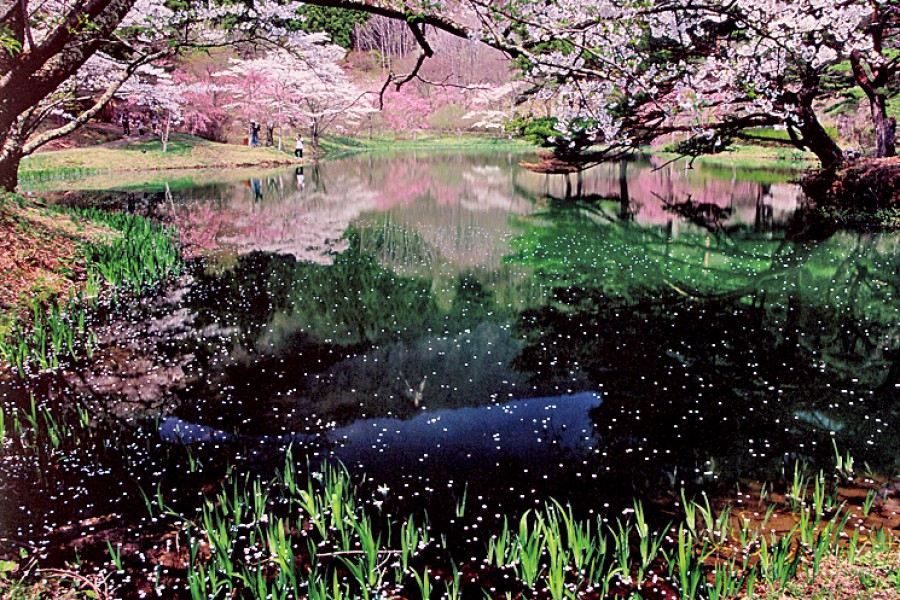
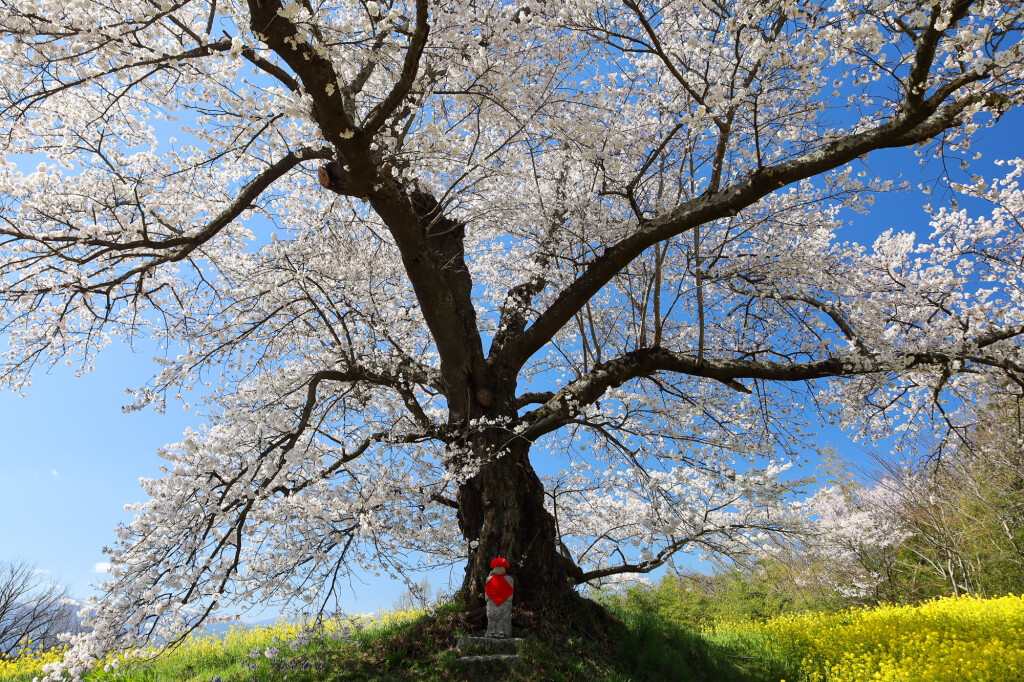
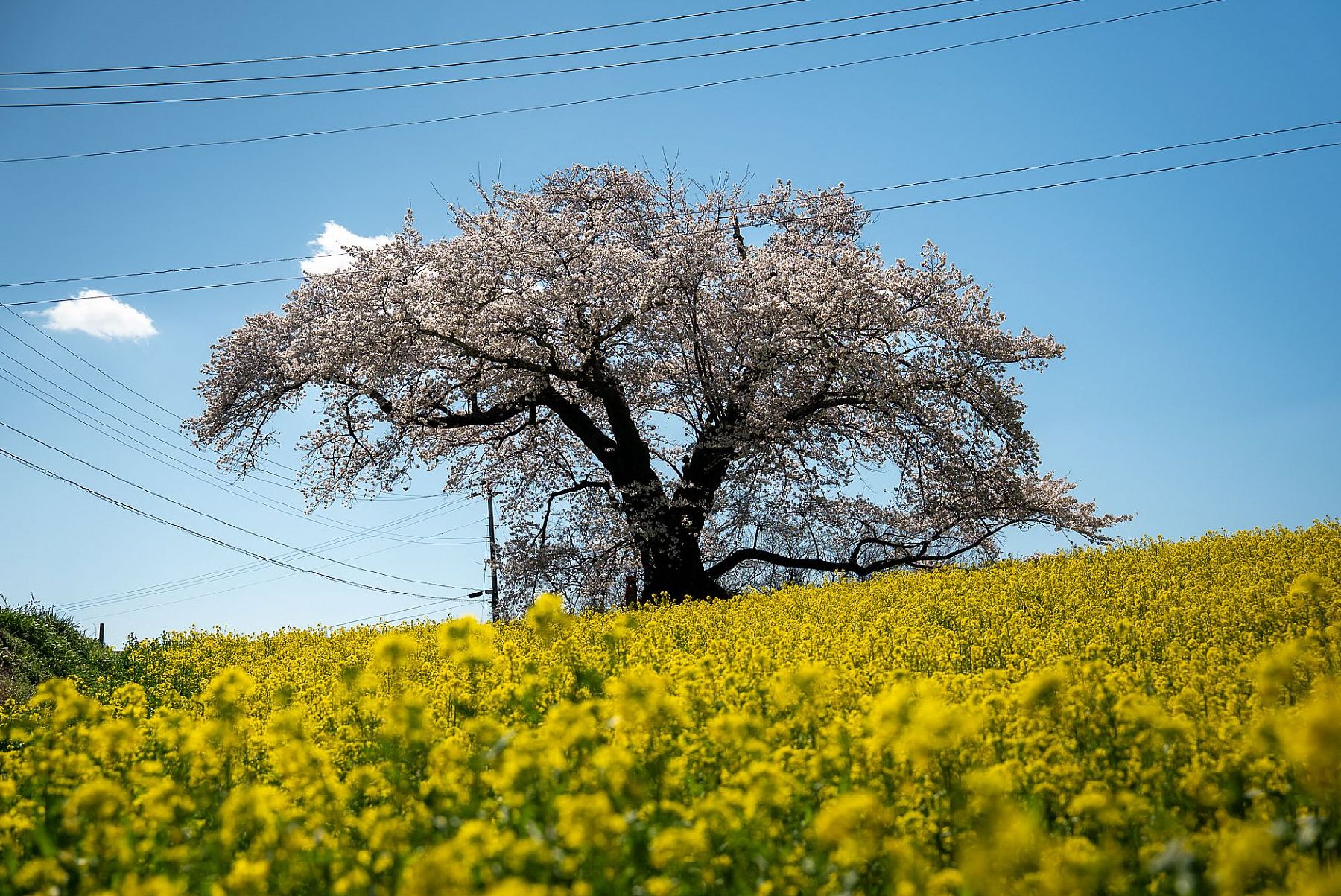
The Hitomachi Jizo Sakura in Hinata is a solitary cherry tree standing along an old mountain pass in Nihonmatsu. Its name comes from the small stone Jizo statue at its base, which appears to be quietly watching over travelers passing through the countryside.

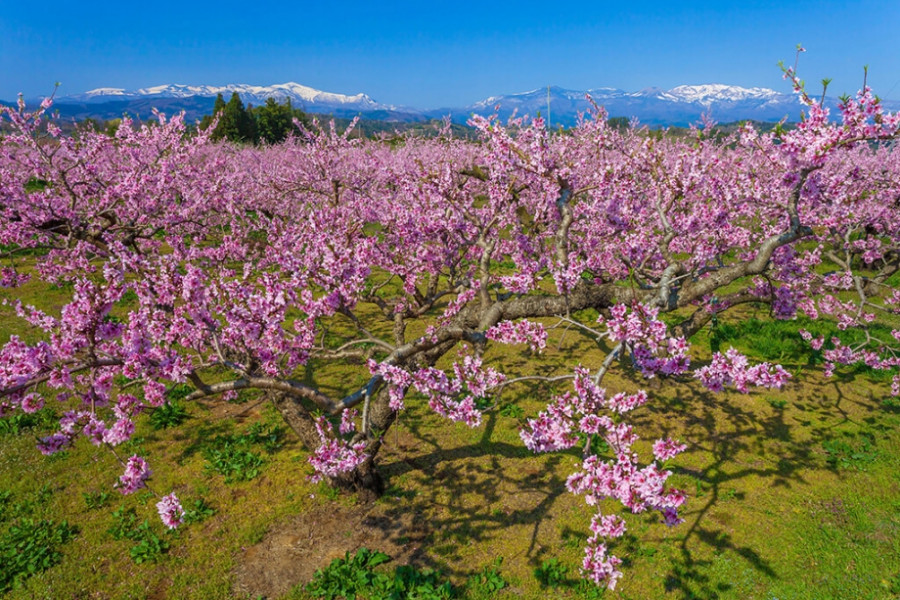
The cherry tree is especially known for the striking combination of pale pink blossoms, bright yellow rape flowers, and the Jizo statue. In the distance, visitors can also see the snow-covered peaks of the Azuma and Adatara mountain ranges, giving the landscape a dramatic backdrop.

Believed to be around 100 years old, the tree is a mature Somei Yoshino with a broad canopy and thick trunk. It blooms from early to mid-April, slightly earlier than some of the other famous cherry trees in Nihonmatsu, and has become one of the most photographed sakura spots in the area.
Venue Details

Venue Details
Best Season
  • Spring
ParkingFree; two parking areas close by
Access Details
AccessHinata-1 Nagaori, Nihommatsu, Fukushima 964-0311
View directions
Getting there

By Car: 45min drive from either Fukushima Station or Koriyama Station

By Train: Nearest station Nihonmatsu Station on the local Tohoku Line; from there 20min bus + 20min walk from Toi-no-kuchi bus stop

Nearby

The World Glassware Hall
History & Culture

Takashiba Dekoyashiki (Takashiba Craft Village)

A traditional craftsmen's village bestowing an air of the olde-worlde. The papier-mâché crafts of the town, made lovingly by hand for generations, will bring a smile to your face. Takashiba Dekoyashiki is an historical craftsmen's village, and was at one time under the protection of the Miharu feudal domain. Dating back 300 years to the Edo Period, this community is said to have been born when a traveller from Kyoto taught the people how to craft papier-mâché dolls using a special paint called 'nikawa'. Take a walk through the nikawa-scented streets of Takashiba Dekoyashiki and step into the Japan of old. Visitors can try their hand at painting various traditional crafts, including the Miharu-koma horse wooden doll.

The World Glassware Hall
History & Culture

Sukagawa Tokusatsu Archive Center

The Archive Center was opened on November 3rd, 2020 in order to share the unique artistry of Tokusatsu (Japanese special effects) with the world. Early Tokusatsu creator and Sukagawa Native, Eiji Tsuburaya came to be known as the “Father of Tokusatsu” due to his incredible Tokusatsu special effects in films such as Godzilla (1954) and television series such as the Ultra-series.Prior to the development of advanced digital and cgi special effects, science fiction films heavily relied on Tokusatsu techniques to create captivating live-action scenes where enormous monsters or Kaijyu wreak havoc upon cities. Smashing and exploding miniature models of cities allowed film makers to create incredible scenes for films and television.The Archine Center stores and displays many historic pieces that were used in or otherwise are related to the production of Tokusatsu films. There is even a special where visitors can watch Tokusatsu artists in action!©円谷プロ

You might also like

Mt. Shinobu (Shinobuyama)
Nature & Scenery

Mt. Shinobu (Shinobuyama)

Mt. Shinobu, with a total altitude of 275 meters, is one of the most recognisable landmarks of Fukushima City. It is estimated that it formed about 500,000 years ago when the Fukushima basin caved in and Mt. Shinobu became an isolated hill, which later became the object of multiple local poems, stories, and legends.Visitors can hike up Mt. Shinobu for unobstructed views of the cityscape. Hikers of all levels can try climbing Mt. Shinobu, as its peak can be reached in a few hours and many parts of it can be reached by car.Each year in April, there is a spring festival with cherry blossom night illuminations that attract hordes of visitors. Summer and autumn are also great times to follow the hiking routes on Mt. Shinobu.A spiritual power spot for locals, Haguro Shrine can be found at the top of the central peak, where there is also a giant straw sandal that weighs about 2 tons and is 12 meters in length and is believed to be among the biggest in Japan. The sandal is paraded along Fukushima City each year in August during the Waraji Festival. Also in Mt. Shinobu, you can find the Shinobuyama Neko Inari Jinja (‘cat shrine’), and the Gokoku Shrine, along with several parks.For stunning views of the city, including the Shinkansen bullet train tracks, head to the Karasugasaki Observation Deck on the western side. Located nearby are the Fukushima Prefectural Museum of Art and the Fukushima Prefectural Library.

Yuyu Land Hanawa Dahlia Park
Nature & Scenery

Yuyu Land Hanawa Dahlia Park

Yuyu Land Hanawa Dahlia Park is located within Yuyu Land Hanawa hot spring and accommodation facility. 300 kinds of 5000 dahlias bloom in approximately 7000 ㎡ site from summer to autumn at the Dahlia Park. Hanawa Town is home to 18 small dahlia gardens including 4 located in elementary and junior high schools. The best time to visit in order to see these flowers is between August and October. An annual dahlia festival is held in Hanawa Town every year to celebrate these vibrant flowers.

Majyo-no-hitomi (The Witch’s Eye Lake)
Nature & Scenery

Majyo-no-hitomi (The Witch’s Eye Lake)

Majyo-no-hitomi, or The Witch's Eye Lake, is a volcanic lake that was formed during a volcanic eruption many years ago. Unique minerals in the water cause the lake to appear different colors, giving the lake its official name of Goshiki-numa (Five Colored Lake), but most often it is a bright blue. The nickname of “Witch's Eye” comes from the unique appearance of the lake that is visible in late spring when the snow melts enough so that only a white ring remains around the lake to form the white of what appears to be an enormous single eye.This lake viewpoint can be reached by an intermediate hike up Mt. Issaikyo that begins at the Jododaira Visitors Center, stop by for a map and safety information before hiking.

Top