Totsube Cherry Tree

Totsube Cherry Tree

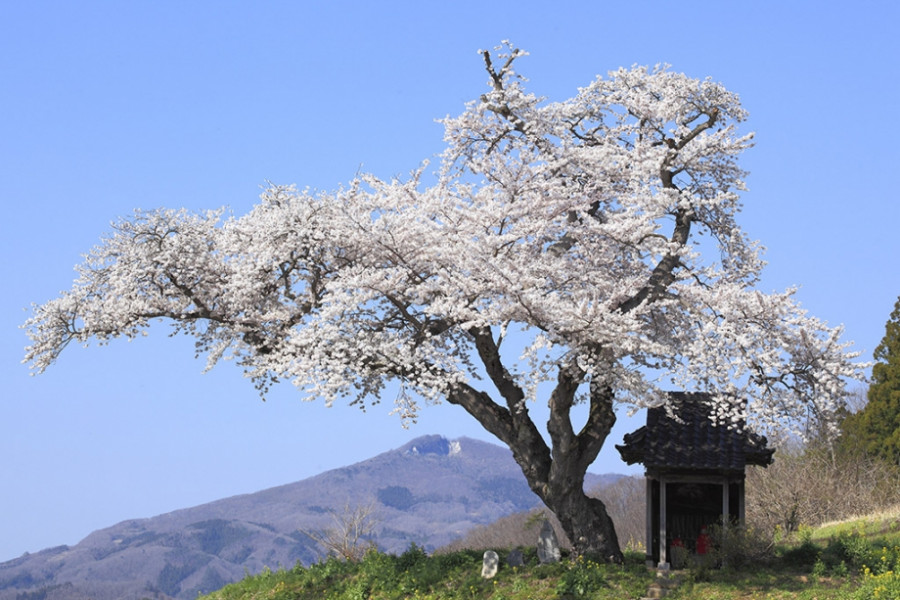
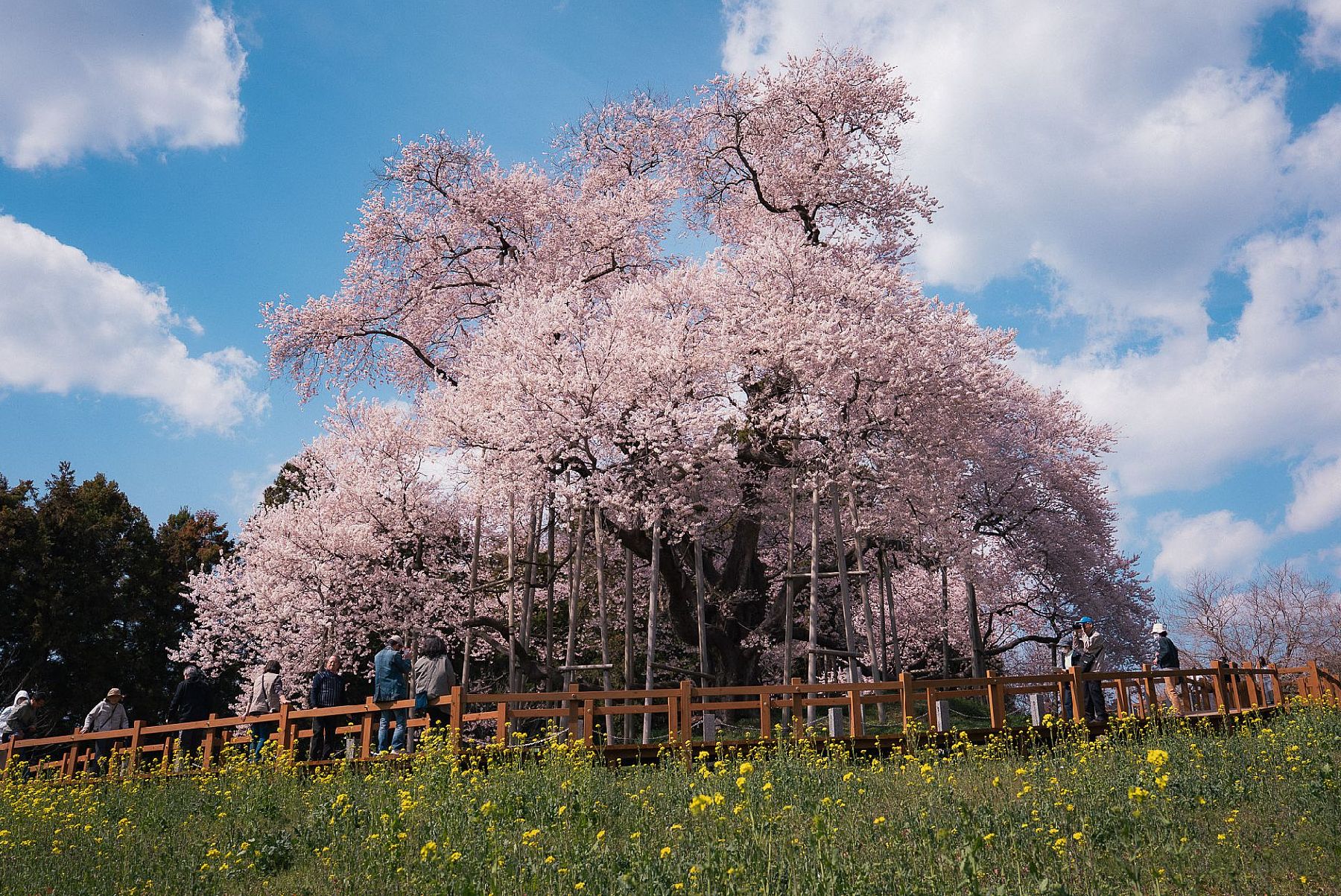
The Totsube Sakura tree is one of the best-known cherry blossom spots in Fukushima. Standing alone in a field in Yamatsuri Town, its wide branches and soft pink flowers create a striking scene against the surrounding countryside. The tree is especially famous for blooming slightly earlier than many other cherry trees in the area and is seen as a symbol of the spring season starting in the prefecture.

Believed to be more than 600 years old, the tree is an Edohigan cherry tree and has been designated a natural monument by the prefectural government. It stands around 18 metres tall, with a trunk more than six metres in circumference, showing both its great age and remarkable size.

For generations, local farmers used the blooming of the Totsube Sakura as a sign that it was time to begin spring work in the fields. Because it flowers from late March to early April, it became closely tied to the rhythms of life in Yamatsuri and remains an important symbol of the town today.

The tree is also popular with photographers, especially because the nearby Suigun Line railway passes behind it. During blossom season, many visitors gather to capture the sight of a local train passing beneath the ancient cherry tree.
Venue Details

Venue Details
Best Season
  • Spring
ParkingFree
Access Details
Access963-5201 Fukushima, Higashishirakawa District, Yamatsuri, Nakaishii, 19-Daiji
View directions
Getting there

By Car: 90mins from Koriyama Station via Yabuki-chuo I.C.

By Train: 30min walk from Iwaki-Ishii Station (Suigun Line)

Nearby

The World Glassware Hall
History & Culture

Fukushima Agricultural Technology Centre

A foothold for the promotion of farming in Fukushima Prefecture - the size of 12 Tokyo Domes!Fukushima Agricultural Technology Centre is a new foothold for the promotion of agricultural in Fukushima Prefecture. It serves as a hub for the spread of technological development and safe agricultural practices, as well as being an important facility for agricultural education.The Centre has strengthened a system of experimentation and research in order to provide technical support to local farmers, and is spreading awareness of the importance of agriculture and of making use of open facilities (such as the Centre's Exchange Building and farming exhibitions) among local consumers and children. The facilities include the Management & Research Building, the Experiment Building, the Exhibition Greenhouse, and the Exchange Building, which is constructed from lumber grown locally in Fukushima Prefecture. From the observation deck, you can take in an expansive view of the entire facility.

The World Glassware Hall
Nature & Scenery

Abukuma Cave

A world of mystical beauty created over millions of years, Abukuma Cave is said to have the greatest variety and the largest number of stalactites in the whole of Asia. It takes about an hour to explore the inner world of the cave and the terrain is easy to navigate on foot.Abukuma Cave is a limestone cave that was discovered in 1969. Inside, visitors can walk the 600-meter-long path to explore and view the beautiful cave formations. Visitors can’t help but be impressed by the beauty of these natural creations formed over the course of 80 million years. The largest hall in the cave, called Takine Goten (Takine Hall), and Tsuki no Sekai (The Moon World), is illuminated with dramatic stage lighting and is particularly impressive.Also not to be missed are the rare cave formations called boxwork, you can identify them by their unique shape; thin blades of minerals coming off the walls and ceilings forming a honeycomb or box-like pattern. Abukuma Cave is the only cave in Japan with boxwork that is open to the public. Another notable stop along the cave path is the Christmas Tree and Silver Frost; both are impressive stalagmites that resemble festive holiday trees. The Christmas Tree is over two meters tall and said to be the largest example in all of Asia.There is an additional thrilling adventure course; experience crawling through narrow passages and climbing a ladder to spectacular views over the cave! This 120-meter-long course runs parallel to the main passage, but please note that visitors may have to crawl on their hands and knees at times.When you have finished exploring the mysterious depths and come back to the surface you can find plenty of restaurants and souvenir shops. Visit from mid-June to July to see the neighbouring hillside covered in 50,000 lavender plants.

The World Glassware Hall
Nature & Scenery

Fujita River Cherry Blossoms

Somei Yoshino cherry blossom trees bloom along both sides of the Fujita River for three kilometers, centering around Horinouchi Bridge near Kikuta Station. The long stretch of leafy foliage features several banks suitable for picnics under the cherry blossoms, which bloom typically in mid-April. (For reference: though blooming periods can change year-to-year, the 2025 blossoms were at full bloom around 15th April.)The riverside is served by nearby Kikuta Station on the Ban-Etsu Line, or there are large car parks near the river walk.

You might also like

Abukuma Cave
Nature & Scenery

Abukuma Cave

A world of mystical beauty created over millions of years, Abukuma Cave is said to have the greatest variety and the largest number of stalactites in the whole of Asia. It takes about an hour to explore the inner world of the cave and the terrain is easy to navigate on foot.Abukuma Cave is a limestone cave that was discovered in 1969. Inside, visitors can walk the 600-meter-long path to explore and view the beautiful cave formations. Visitors can’t help but be impressed by the beauty of these natural creations formed over the course of 80 million years. The largest hall in the cave, called Takine Goten (Takine Hall), and Tsuki no Sekai (The Moon World), is illuminated with dramatic stage lighting and is particularly impressive.Also not to be missed are the rare cave formations called boxwork, you can identify them by their unique shape; thin blades of minerals coming off the walls and ceilings forming a honeycomb or box-like pattern. Abukuma Cave is the only cave in Japan with boxwork that is open to the public. Another notable stop along the cave path is the Christmas Tree and Silver Frost; both are impressive stalagmites that resemble festive holiday trees. The Christmas Tree is over two meters tall and said to be the largest example in all of Asia.There is an additional thrilling adventure course; experience crawling through narrow passages and climbing a ladder to spectacular views over the cave! This 120-meter-long course runs parallel to the main passage, but please note that visitors may have to crawl on their hands and knees at times.When you have finished exploring the mysterious depths and come back to the surface you can find plenty of restaurants and souvenir shops. Visit from mid-June to July to see the neighbouring hillside covered in 50,000 lavender plants.

Hanamomo-no-Sato Park
Nature & Scenery

Hanamomo-no-Sato Park

From early April right up to the start of May, 40 varieties of blossoming peach trees present a feast for the eyes for visitors to Hanamomo-no-Sato Park. There are over 300 peach trees spread across the 8,000 square meters of land. From blossoms with a single layer of petals, to the elaborate Yae-zakura and Kikuzaki Sakura flowers, there is a huge variety in the shapes and colours of cherry blossoms to be discovered and enjoyed at Hanamomo-no-Sato Park. As well as being free to visit, Hanamomo-no-Sato Park is conveniently located; just 20 minutes on foot from Iizaka Onsen Station.

Top