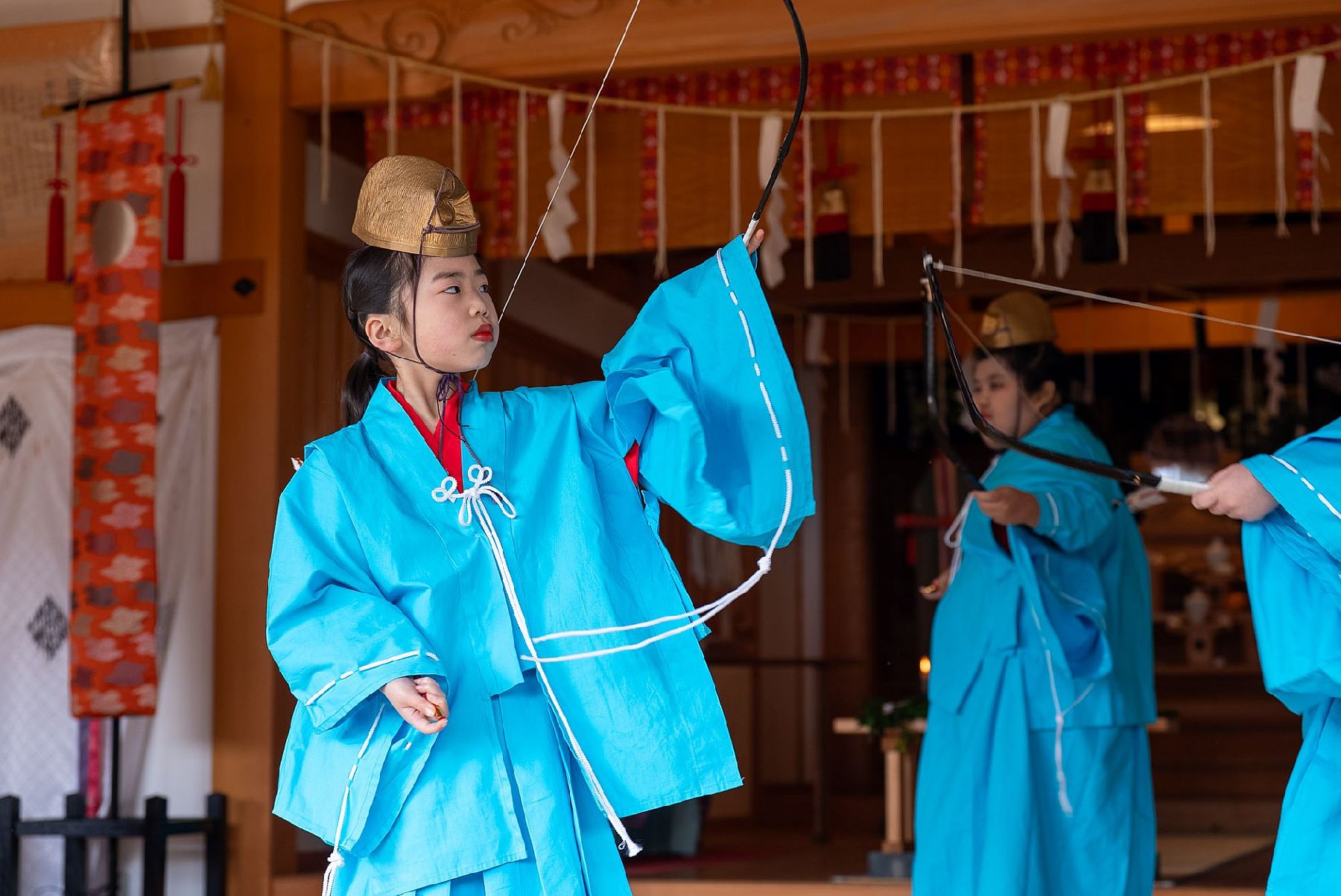
The miko dance at Bandai Shrine is a traditional sacred performance passed down through generations in Bandai Town. It's performed as part of the wider Funahiki Festival, held on the spring equinox in March, which is a ritual to divine the year’s harvest. The dance itself is deeply connected to local beliefs and has long been preserved as a ceremonial offering to the gods.
The dance is performed primarily by young girls, ranging from kindergarten age to junior high school students. They carry out the ritual movements in front of the shrine, to a musical accompaniment of drums and flutes. This intergenerational participation plays an important role in preserving the tradition and passing it down within the community.
The performance consists of three distinct dances: the Sakaki Dance, the Bow Dance, and the Sword Dance. Each uses different ritual objects and has its own meaning and choreography. For example, dancers hold sacred sakaki branches, bows and arrows, or swords depending on the piece, reflecting ancient ceremonial practices that have been maintained over time. The dances are usually divided by age group.
Typically performed by a group of four dancers, the choreography incorporates circular formations and flowing movements. Its style is considered somewhat unique, bearing closer resemblance to older forms of court or ritual dance than to more commonly seen shrine dances. Although its precise origins are unclear, it remains an important and protected element of the area’s intangible cultural heritage.
The 'funahiki' tug-of-war event is open to anyone - please apply by 1pm before the contest starts at 2pm - and takes place shortly after the dancing is complete.
The shrine is just down the road from the beautiful Enichiji Temple, although entry to the deepest part of the temple is typically restricted until the start of April.